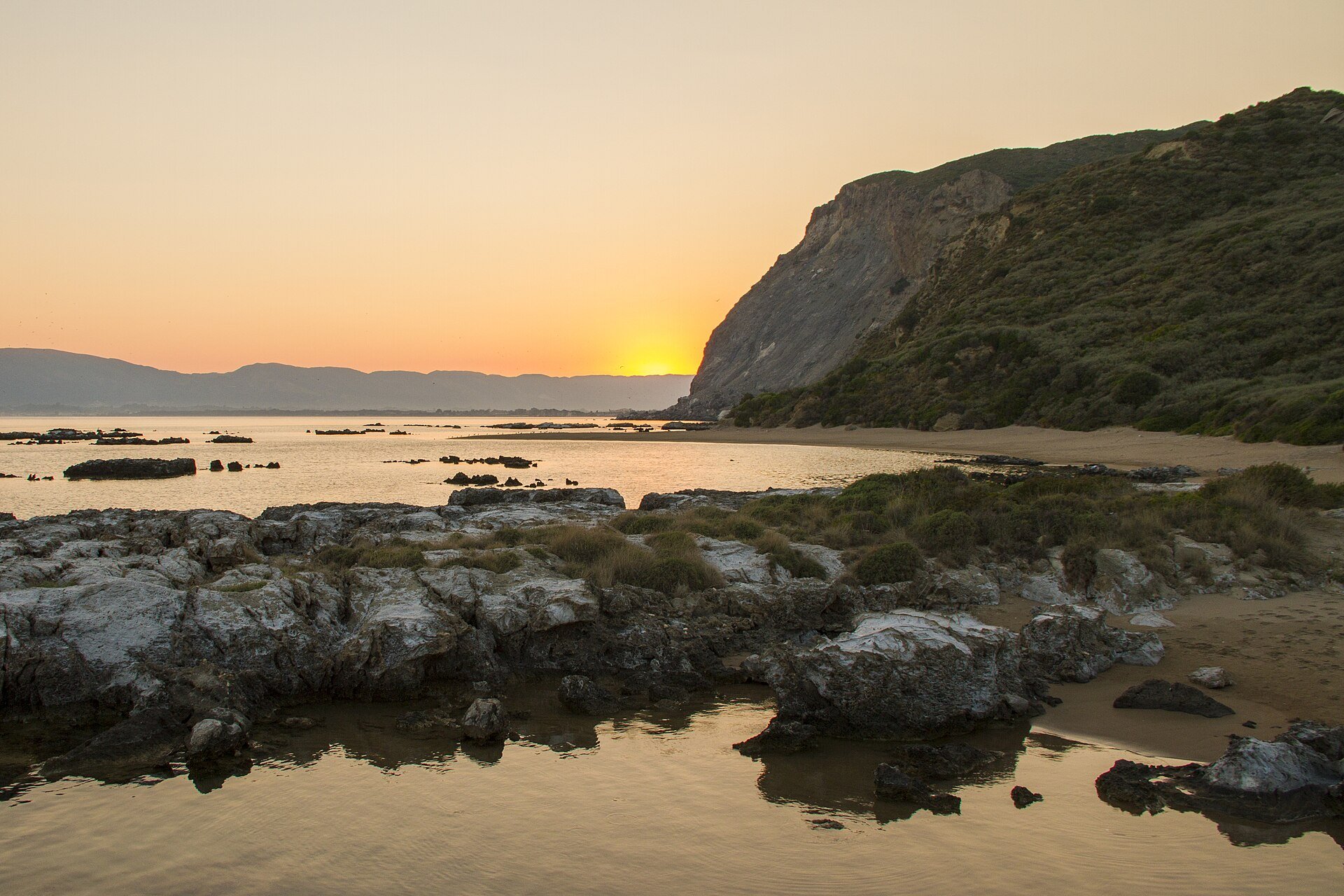
Kalamaki is a legitimate alternative to Laganas with far fewer people. Walk to the southern end near the protected zone and you'll often have 200 metres of beach almost entirely to yourself.
Kalamaki Beach — The Turtle Coast’s Quiet Neighbour
Kalamaki doesn’t advertise itself. It sits on the edge of the National Marine Park of Zakynthos, just east of the Laganas resort complex, and does its best impression of a beach that simply exists — no grand entry gates, no hawkers, no competing sound systems from rival bars. It is, in the best possible way, a beach that hasn’t tried too hard.
What Awaits You
A wide, gently curving stretch of fine golden sand — roughly 2 kilometres of it — backed by low dunes and, at its southern end, the formal boundary of the protected nesting zone. The water shares the same turquoise warmth as the rest of Zakynthos’s southern coast, the slope is gentle, and the sea floor is clean sand without sharp stones.
Where Kalamaki differs from Laganas (its louder neighbour 2 km to the west) is in scale and tempo. The village of Kalamaki itself is small and genuinely lived-in rather than purpose-built for tourism. The beach has some organised sunbed areas near the northern end, but move southward and the infrastructure dissolves into open sand. Wind, light, and the distant sound of the Ionian — that’s your soundtrack.
Because Kalamaki falls within the Marine Park zone at its southern end, nesting season (June-August) brings the familiar but important restrictions: beach closure from dusk to dawn, protected nest markers, and no lights after dark. What this also means is that the beach sees significantly less development pressure than non-protected areas. The dunes at the back are intact, the sand is clean, and the atmosphere is noticeably calmer than anywhere on the main Laganas strip.
Loggerhead turtles nest on Kalamaki’s sand every season, and if you’re an early riser in June or July, turtle tracks — the distinctive dual flipper marks that look like tractor tread — are a regular sight in the morning sand. Don’t follow them, don’t disturb the nests, and resist the urge to dig. Just appreciate what you’re seeing.
Getting There
Kalamaki village is 10 km south of Zakynthos Town, signposted from the main coastal road. The drive takes about 15 minutes. There’s a small free car park near the beach access point in the village, and several informal parking areas along the beach road.
Local buses from Zakynthos Town stop in Kalamaki village — check the KTEL schedule for current times. A taxi from town costs roughly €10-12.
Facilities
- Sunbeds and umbrellas: Available at the northern end of the beach (€8-10 per set)
- Tavernas: 2-3 options in the village, 5-10 minutes’ walk
- Mini-markets: Basic supplies in the village
- Showers: At the northern beach access point
- Parking: Free, limited spaces near the beach
The southern section has no facilities — bring water, food, and everything you need.
Insider Tips
Kalamaki is one of those beaches that rewards loyalty over a trip. Come on consecutive days and you’ll notice the rhythms — which part of the beach the morning wind avoids, where the water is shallowest and most forgiving for young swimmers, where the light hits perfectly in the hour before noon. It’s a beach for people who want to actually be at the beach, not perform being at the beach.
The village taverna nearest the beach does excellent fresh fish. Not fancy, not tourist-menu standard, just good Greek food at honest prices. Go for lunch rather than dinner — the evening trade is thin and some kitchens wind down early.
For turtle track spotting, arrive between 7-8 AM during June and July. Nesting females come ashore between midnight and dawn, so by morning their tracks are fresh. The Marine Park wardens are sometimes present early and are uniformly knowledgeable and happy to explain what you’re seeing.
If you have children, the shallow and calm water in the central section of the beach is close to perfect. The beach slope is so gentle that even toddlers can wade in without alarm. The lack of jet ski traffic (prohibited in the protected zones nearby) adds a further layer of calm.
Marine Park Rules at Kalamaki
The southern section of Kalamaki beach is formally within the Marine Park. Rules that apply here:
- Sunset to sunrise: Beach closed to all visitors during nesting season
- Nest markers: Roped cages mark active nests — never cross or touch these
- No lights: Torches, phone screens, and car headlights near the beach disorient turtles
- No digging: Sand disturbance near the dunes can destroy hidden nests
- Quiet: Unnecessary noise disturbs nesting behaviour
These are not suggestions. Marine Park wardens patrol regularly and can issue significant fines.
Best Time to Visit
Sweet spot: May-June and September. Golden-hour light, warm but not brutal sun, uncrowded.
Peak season: July-August. Still good but more people, and the beach restriction zone means the swimmable area concentrates beachgoers somewhat.
Avoid: Late August midday in extreme heat — there’s limited natural shade, and the open dune area reflects heat intensely.
Tourist vs Local Perspective
Kalamaki is where you’ll find the Zakynthian families who want a proper beach day without the Laganas circus. They bring their own umbrella, their own food, their own folding chairs, and they stay for six hours. Watch them and you’ll understand that Kalamaki isn’t a compromise between Laganas and the protected beaches — it’s a genuine first choice for people who’ve tried everything and settled here. That’s the highest endorsement a beach can get from people who actually live on the island.